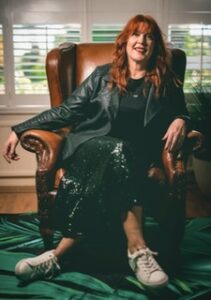
Like many of us celebrants, I’m an ex-teacher. We have a lot of transferable skills suited to this job – holding an audience, engaging with people and being both enthusiastic and serious when the situation calls for it.
For my educational career, I completed a 4 year B.Ed Honours degree in education and child development, a NPQH for Headship, a CIPD in PersonnelManagement, and over a decades worth of CPD courses for most every curriculum subject, including an applied SEN mediation certificate. I wanted and needed every single one of those qualifications in order to do my job effectively, to be a better teacher, PGCE trainer, NQT mentor, team leader and senior manager. Ofsted, parents, children and colleagues reckoned I was pretty damn good.
But I came to celebrancy not straight from the classroom, but after that – from the creative worlds of art, design and literature.
I translated French texts for a Brussels art museum, wrote and self published two books, sold and exhibited my artwork, created promo vids for small businesses, designed a website, wrote a monthly blog for the International Golf Club, was a freelance proof reader for online training at a global pharmaceutical company and ran my own fashion brand designing nightwear – and for each of those things, I HAD NO QUALIFICATIONS WHATSOEVER. How do I know I was any good? I got repeat work, orders, compliments and thanks.
What attracted me to being a celebrant was the creative writing.
Back in 2020, I picked a training course based on price and one that was Independent – I did not adhere to the Humanist doctrine, nor the ‘heart-led’ spiritual stance. Independent meant True To The Client – not me. I liked that – it was like doing a
painting commission. The fact it had the NOCN Level 3 in Civil Celebrancy attached to it, of course, appealed to the teacher in me. A recognised qualification would quash any feelings of Imposter Syndrome. It would give me clout. I could show it to clients and prove I was competent! I would surely be better than a Celebrant without the qualification, or at least it would set me apart from them. And if/when the law changed so that celebrants could legally wed couples, the official qualification probably would be required – so, may as well do it, just in case.
The NOCN is A level standard: essay writing coursework with a few face to face assessments. I found it a bit of a chore to complete, taking me back to the hoop-jumping days of teaching criteria tick boxes. It’s completely self-learning, so you need to be motivated to complete your assignments. For support, my training provider had online group tutorials on what was required. They were the ones who marked it and passed or failed it. (not a person from NOCN). If you didn’t pass, you resubmitted until you passed (or gave up!).
The NOCN content wasn’t particularly enlightening, although I enjoyed finding out about the history of celebrancy with its beginnings in Australia. If you want to know more about that, just read “Murphy’s Law and the Pursuit of Happiness:
A History of the Civil Celebrant Movement” by Dally Messenger III (Cool AF is our Dally!).
Here’s what the modules consisted of:
Health & Safety (Don’t stand near an open grave in muddy weather, unsupervised candles, watch out for fainting grannies, tell everyone when you’re going alone into a stranger’s house… that sort of thing)
Equality & Diversity (OBVS!)
Understanding Professional Civil Celebrancy in the UK (How the Humanists hijacked Dally, and the role of the celebrant)
Understanding Celebratory Civil Ceremonies in the UK (the statutory stuff)
Planning & Delivery: Celebratory Civil Ceremonies in the UK (get wed, civil partnerships, namings, vow renewal, commitment) This covered script structure and delivery but not actually writing a full script.
Understanding the UK Funeral Industry – The ‘stuff that’s always been done this way’. Needless to say, when I quoted the Coffin Club manifesto in this assignment, the feedback was “you have managed to research some more unusual ones like ‘The Coffin Club’ which is an interesting read”. (I was teaching them something they didn’t know lol!)
Creating & Conducting a Civil Funeral Service –FDs (Funeral Directors) and how you should speak and dress at a funeral. Write 2 funerals, put them into presentation scripts to give to clients, write 3 eulogies for an old person, a young
person and a person with no family or friends. Feedback consisted of a criticism of my introducing myself as Babs not a solemn ‘Barbara’, and use of the word devastation as too harsh. My response was blunt “We are not Victorian. A funeral should be honest and acknowledging. Death is not talked about enough.” My mention of Soul Doulas was met with another surprised/unheard of ‘well researched’ (no, I just follow Katie Costello on Facebook!)
Working with the Bereaved – grief, interviewing families and ‘appropriate language and tone’. (don’t use THAT voice!)
So I now had a certificate of attendance to a 5 day course learning what a celebrant does. I also had an officially recognised qualification in Civil Celebrancy. But I had no confidence to go out and get bookings. I’d only seen a video of one funeral and bits of a wedding. Never wrote a wedding script. Most of my cohort felt the same, asking to shadow celebrants in their area and cringing at taking biscuits to FDs…
So when did I feel ready to go out and do my first funeral and wedding?
I was finally up for it, after doing the Match & Dispatch Celebrant Plus training for weddings and funerals! Instead of teaching you WHAT a celebrant is, M&D teaches you how to BE a celebrant. In. Real. Life.
My first clients had no interest in my qualifications. They chose me to do their ceremonies because I was ME. They had no doubt in my abilities – what they wanted was my style, my attitude and the way I wrote. And that’s what a celebrant brings that a Registrar or Clergy doesn’t. We aren’t generic!
Doh! Light Bulb Moment!
And the longer I’ve been in Celebrant World, I realise that the day when we can legally wed couples is way off yet. And when that happens, it won’t be only those of us with qualifications that get to do it. I doubt that will even be part of an application process. It will be probably be a simple course that individuals will pay to do – the same one that Registrars do in a few days – in order to prove they can complete legal paperwork correctly and according to the required statutory obligations. Having an A level equivalent in Celebrancy won’t have any bearing IMHO.
By the way, there is also an NOCN qualification for both Funerals and Couples/Naming. Looking at those modules – it is all already covered in the joint NOCN Civil Celebrancy that I did. Maybe they’re just for those who home in on the one area, maybe it’s a way of getting you to pay more… (cynical me!) In hindsight, my reasons for having the NOCN qualification were unfounded. It didn’t give me any clout, or ease any Imposter Syndrome. It does what all good qualifications do – it increases your knowledge and understanding. That’s vital if you’re a teacher, doctor or an electrician. But if you’re an author, an actor or even a celebrant – it’s just info to file away (literally, in my case, at the back of my filing cabinet).
Just bear in mind, not all qualifications move you forward. I know this because I spent many a year comforting my 7 year olds as they were put through SATs. And just because you have a qualification, doesn’t mean you are qualified. I also have an A level in Islam. It means I have some basic understanding of the religion; it doesn’t mean I’m a Muslim. So if you’re worried that Match & Dispatch don’t cover the NOCN qualification, don’t. They have spent time investigating what the NOCN covers, and they cover
it all in their training. Make your own mind up as to whether you feel you’d benefit from the NOCN. (If I
was being overtly persuasive, I’d say ‘the clue is in the name…’)
Match & Dispatch are real-lifers, rather than theorists. It’s creative thinking, rather than generic thinking. Their training focuses 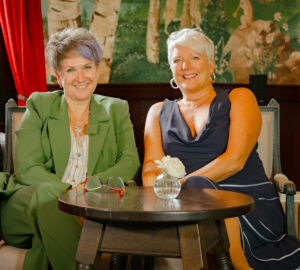 on teaching you how to find your voice and write great scripts (in full, with loads of help), giving you guidance on being creative, showing you lots of examples, telling you how it is to be a sought-after celebrant, and the realities of how to make a living from it. And you can pay for it in instalments, which I don’t think any other provider does. I could have done with that back in 2020.
As someone who had a career assessing teacher performance and learning outcomes, I would coin the phrase used by Ofsted and say that the training provided by Match & Dispatch is ‘Outstanding’.
Oh, hang on… it says that on their logo doesn’t it?

AUTHOR: Babs is an Indie Celebrant from Ceremony City. Passionate about
writing. Inspired by music, art & literature. Rebel ‘tude.