
If you’ve been Googling celebrant training online, chances are you’ve found yourself faced with a bewildering number of options.
Online courses. Residential courses. Self-paced courses. Live Zoom training. Five-day intensives. Courses promising you can be a fully fledged celebrant before you’ve really had time to work out what being a celebrant involves.
So, is online celebrant training actually a good way to learn?
We think it is.
Obviously, we would say that – our celebrant training is online.
It’s because becoming a really good celebrant takes time.
Not necessarily years. Not even months and months.
But it does take time to learn, absorb, practise, get things wrong, receive feedback, try again and get better.
And that’s particularly true when it comes to one of the most important celebrant skills of all.
Writing.
You can’t learn to write a brilliant ceremony in five days
Most residential celebrant training courses run from Monday to Friday.
And there’s certainly something appealing about immersing yourself in something completely for five days. You can learn an enormous amount.
You can learn about the role of a celebrant. You can learn how a ceremony is structured. You can discuss meeting couples and families, symbolic elements, music, readings, vows and all the other things that go into creating a ceremony.
But Monday to Friday doesn’t give you much time to process what you’re learning.
If you learn something on Monday, practise it on Tuesday, get feedback on Wednesday and need to rethink your approach, you’ve got Thursday and Friday left.
And then you’re finished.
That’s particularly important when it comes to writing.
Because you can’t magically become a brilliant ceremony writer between checking into your accommodation on Monday and packing your suitcase on Friday afternoon.
Writing is a craft.
And celebrant writing is a very particular craft.
You aren’t writing an essay. You aren’t writing a novel. You aren’t writing something designed to be silently read from a page.
You’re writing words that will be spoken aloud, to real people, in a room full of emotion.
Those words have to sound natural. They need rhythm. They need warmth. They need to capture someone’s personality. They need to make people laugh without trying too hard and move people without becoming mawkish.
And, crucially, they need to sound like the people the ceremony is about – not like the celebrant who wrote them.
That takes practice.
Good celebrant training needs to give you time to improve
This is where we think online celebrant training has a real advantage.
You don’t have to learn everything between Monday morning and Friday afternoon.
You can watch a module. Think about it. Go away and try something. Come back to it.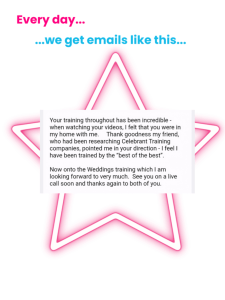
You can write a piece, leave it overnight, read it again the following morning and wonder what on earth you were thinking.
Then you can make it better.
You can submit a script, receive detailed feedback, take that feedback away, understand it and apply it to the next piece of writing.
And gradually, you improve.
That space between learning and doing is important.
Because training shouldn’t just be about consuming information.
It should change your practice.
Feedback matters – and ‘that’s lovely’ isn’t feedback
One of the things we’re slightly obsessive about at Match & Dispatch is script feedback.
Because if you’re going to train to become a celebrant, someone needs to actually look at your work and tell you how to make it better.
Properly.
That doesn’t mean covering it in red pen and destroying your confidence.
Nor does it mean saying, ‘Oh, that’s lovely!’ and sending you on your merry way.
Detailed feedback should tell you why something works.
And why something doesn’t.
Where you’ve overwritten.
Where you’ve repeated yourself.
Where you’ve slipped into cliché.
Where something sounds lovely on the page but is going to be an absolute mouthful when you try to say it aloud.
Where you’ve missed the most interesting part of someone’s story.
Where you’ve made yourself the focus rather than the couple or the person who’s died.
And, just as importantly, where you’ve absolutely nailed it.
Our script feedback takes time because we take writing seriously. We want you to understand the editorial decisions behind the feedback so that you can apply what you’ve learned to the next script – and the one after that.
That’s how your practice improves.
Flexible celebrant training doesn’t mean you’re on your own
There’s another misconception about celebrant training online that we’d quite like to chuck in the bin.
Flexible doesn’t have to mean unsupported.
We designed our courses so that you can work through them around the rest of your life – because most people training to become celebrants already have one of those.
Jobs.
Children.
Parents.
Dogs.
Holidays.
The occasional desire to spend an evening watching telly rather than learning about ceremony structure.
But flexibility shouldn’t mean buying a collection of videos and being abandoned with them.
Our online celebrant training includes the course materials, comprehensive workbooks, example scripts, detailed feedback and regular live tutorials where you can ask questions, discuss what you’re learning and learn from other people too.
And you have lifetime access to the course.
Because we don’t expect you to remember everything the first time you hear it.
Sometimes you need to go away and have a think
This sounds ridiculously simple, but it’s one of the things we value most about self-paced learning.
Thinking time.
We’ve both been working in weddings and funerals for more than 20 years. We still think about how we could have worded something differently. We still learn from ceremonies. We still notice things that make us rethink the way we work.
 Good celebrants are reflective practitioners.
They don’t simply learn a formula and reproduce it.
They ask themselves:
Did that work?
Why did it work?
Could I have asked a better question?
Did I really capture those people?
Was that section too long?
Could I have said that in six words instead of sixteen?
Did that sound like them – or did it sound like me?
That habit of reflecting on your own work should start during your training.
And flexible online celebrant training gives you the space to do it.
Online wedding celebrant training
If you’re looking specifically for online wedding celebrant training, time to practise is particularly important.
Wedding ceremonies can look deceptively easy.
Everyone’s happy. There’s confetti. Nobody has died. How difficult can it be?
Quite difficult, actually.
You’re taking the story of two people – often years or decades of it – and turning it into something entertaining, meaningful and recognisable.
You need to know what to ask them.
You need to know which bits of the resulting mountain of information matter.
Then you need to shape it into a ceremony that has pace and structure without sounding formulaic.
And then you have to deliver it.
That takes more than learning which bit traditionally comes before the vows.
Online funeral celebrant training
The same applies if you’re considering online funeral celebrant training.
 Funeral celebrancy brings a different set of challenges.
You’re meeting people at an incredibly difficult time. You may have one meeting in which to gather everything you need. Family relationships can be complicated. The person who has died may have lived for 95 years or 19. They may have been adored. They may have been difficult. Often, they were both.
You have to listen.
You have to find the story.
And then you have to write something truthful, appropriate and human.
Again, that isn’t a skill we’d want to cram into five intensive days and tick off as ‘done’.
How long should online celebrant training take?
This is a bit of a ‘how long is a piece of string?’ question.
One of the benefits of self-paced celebrant training is that different people can move at different speeds.
If you have plenty of time available, you may progress quite quickly.
If you’re fitting your training around a full-time job and three children, it may take longer.
Neither makes you a better or worse student.
What we would be wary of is making speed the goal.
Finishing a celebrant course isn’t the same as being ready to work as a celebrant.
We’d much rather you took a little longer, practised properly, acted on your feedback and finished the course feeling confident in what you can actually do.
Because your first couple or bereaved family aren’t going to ask whether you completed your training by Friday afternoon.
They’re going to care whether you’re any good.
So, is celebrant training online worth it?
We think the more useful question is:
Is the online celebrant training you’re considering actually going to teach you to be a good celebrant?
Look beyond the fact that it’s online.
Find out what you’re actually getting.
Is there an opportunity to practise?
Will anyone read your work?
How detailed is the feedback?
Do you have time to take that feedback away and put it into practice?
Can you ask questions?
Is there live support as well as recorded material?
Can you revisit the training later?
Who created the course – and do they actually do the job they’re teaching you to do?
Those things matter far more than whether you and your trainer happen to be sitting in the same room.
The best celebrant training shouldn’t simply give you information.
It should give you the opportunity to develop a craft.
And sometimes the best way to do that isn’t to rush.
It’s to learn something.
Go away.
Try it.
Think about it.
Get some proper feedback.
And come back better.
That’s exactly why we chose to make Match & Dispatch celebrant training online and flexible – but very definitely not ‘quick’.
Because we’re not interested in how fast you can finish your celebrant training. We’re interested in how good you are when you do.
Want to find out more? Take a look at our online celebrant training courses HERE.
Or, if you’d rather talk to actual human beings before deciding, come along to one of our Monday Meet-ups. Ask us anything. We really don’t mind.

Kate & Kate


